
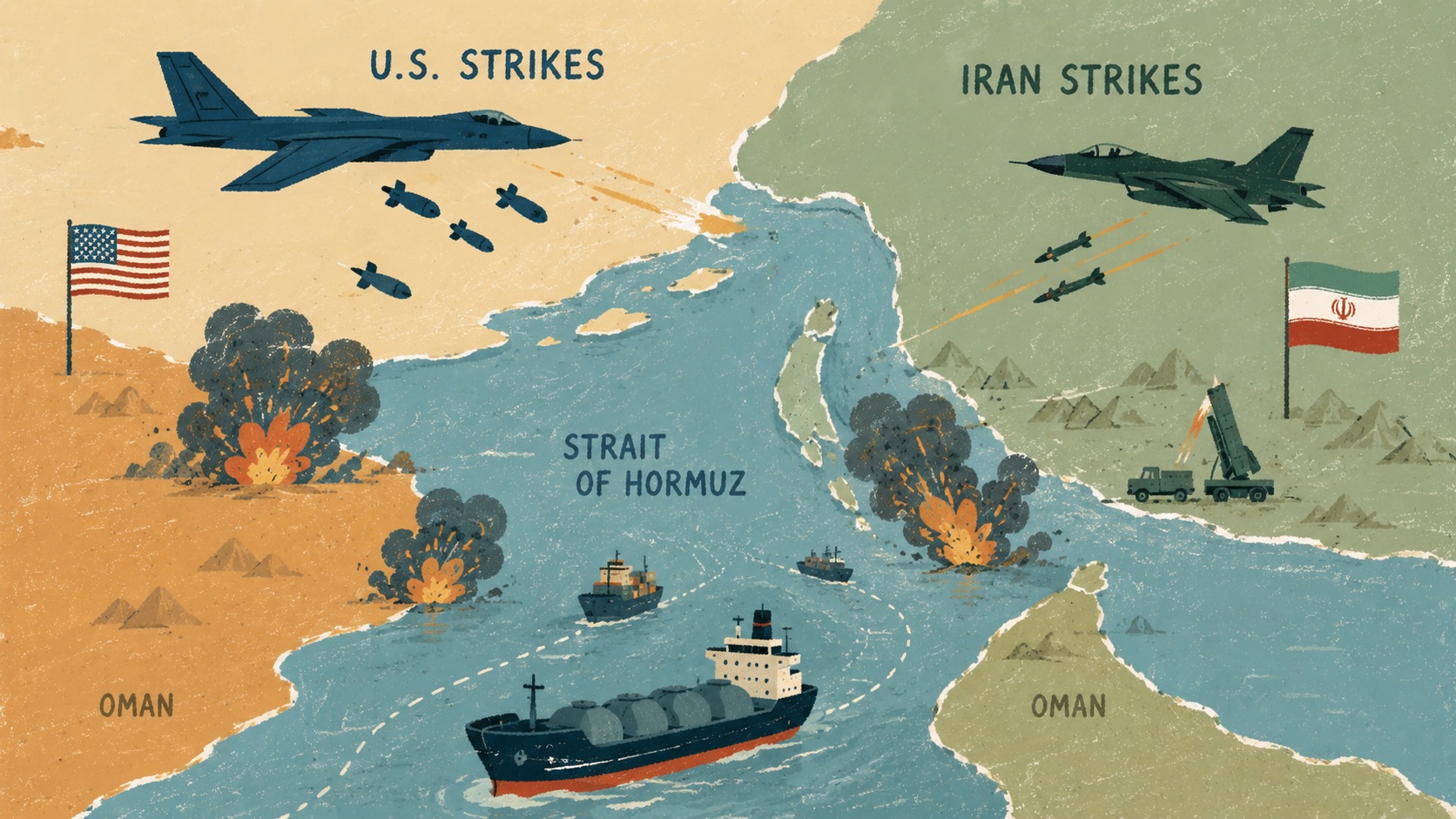
The US launched retaliatory strikes against Iranian missile and drone storage sites in response to a drone attack on a cargo ship in the , marking the most significant test of a reached just a week earlier. This exchange threatens to reignite full-scale war that began with in February, risking massive displacement and economic disruption across the Middle East as both nations face the stakes of breaching their ceasefire.
President Trump announced a temporary pause in US-Iran negotiations to coincide with the mourning period for former , granting Iran a 'week off' for the funeral. Sources confirm that between the two nations are scheduled to recommence in Pakistan on July 11, focusing on , , and .
Iran's joint military command issued a new warning that all oil tankers moving through the must use approved routes, reinforcing its claim of jurisdiction over the waterway. This directive comes as commercial traffic rebounds but remains patchy and unpredictable.
The United States and Iran clashed at the on July 2, with US Ambassador warning that President Trump's patience is 'not unlimited' regarding Iranian attacks on Arab neighbors and commercial shipping. Iran's delegation confirmed talks in Doha concluded with mediators but without direct US engagement.
Mediators from Qatar and Pakistan confirmed that the next round of will be postponed until after the funeral processions for former , which begin July 4 and conclude with burial on July 9. The pause was agreed to allow diplomatic progress without military escalation.
Iran's Deputy Foreign Minister Kazem Gharibabadi announced Tehran will establish a '' with Washington to report breaches of the signed two weeks prior. The channel aims to address and ensure implementation of the and .
Peace negotiations in Doha have stalled as Iran refuses direct talks with US envoys and over frozen assets and the . The summit was downgraded to indirect technical discussions, with Qatari officials confirming US envoys met only with mediators. Iran's top negotiator warned Tehran will not entertain direct talks until initial conditions, including sanctions lifting and access to financial reserves, are upheld.
Iranian Foreign Ministry spokesperson Esmaeil Baghaei reiterated that no meetings at any level with the American side are scheduled for the coming days, explicitly ruling out direct talks with US envoys Jared Kushner and Steve Witkoff. Iran insists outstanding must be resolved before discussing contentious matters like , casting fresh doubt on .
Qatar's Foreign Ministry officially stated that US envoys Steve Witkoff and Jared Kushner, who arrived in Doha for talks, will not hold direct discussions with Iranian officials. The ministry noted that the $6bn in frozen Iranian funds have not yet been transferred and that their transfer depends on the progress of negotiations between .
Iran's Ministry of Foreign Affairs refuted any planned meeting with the United States in Doha, stating it is sending an solely to discuss the release of frozen Iranian assets. This directly contradicts 's claim that high-level meetings are scheduled, clarifying that no negotiation meetings with the US are planned in the coming days.
Indirect talks between US and Iranian officials regarding the unfreezing of at least will recommence on Wednesday in Doha, Iran confirmed. The US team is seeking details on a plan for Iran to charge tolls in the Strait of Hormuz, while Qatar's foreign ministry stressed that US envoys and are meeting only with Qatari mediators, not Iranian officials.
An Iranian official stated that Iran's delegation will be in , but explicitly denied it will be for talks with the United States, contradicting that high-level meetings are scheduled. The spokesman clarified that Tehran is sending its delegation to discuss terms without US involvement, while noting no negotiation meetings with the US are scheduled in the coming days.
The United States and Iran have agreed to '' following an exchange of strikes over the past few days, with a US official confirming that vessels will now be able to move through the freely. Both sides plan to resume in on Tuesday, despite recent accusations of and reciprocal attacks on military sites in Kuwait and Bahrain.
Two of the targets struck by in the on Saturday night were newly built by Iran, according to a source familiar with the details. The strikes also hit other targets not attacked before, including surveillance infrastructure, communications systems, air defense sites, and mine-laying capabilities.
The strikes destroyed newly built Iranian targets plus other unattacked capabilities including surveillance infrastructure, communications systems, air defense sites, and mine-laying capabilities. Two of the four targets were newly constructed by Iran according to a source familiar with the details.
Iran's Islamic Revolutionary Guard Corps Navy command stated that American bases 'will experience hell in these coming days' as reciprocal strikes continued into Sunday. The IRGC warned that US strikes violated the ceasefire and that attacks 'will result in the complete halt of all diplomatic processes'.
The IRGC warned that American bases will face intense reciprocal strikes in the coming days as retaliation continues into Sunday. This threat follows US strikes violating the ceasefire, which the IRGC claims will result in the complete halt of all diplomatic processes.
The IRGC stated that US strikes violated the ceasefire agreement, and these attacks will result in the complete halt of all diplomatic processes. This warning accompanies their claim that US bases will experience hell in the coming days due to continued reciprocal strikes.
Iran's confirmed launching missile and drone operations targeting US military sites in Kuwait and Bahrain, including in Kuwait. Bahrain reported a residential building damaged by overnight attacks with no loss of life, while Kuwait's army stated air defenses were responding to hostile attacks.
No, Bahrain reported a residential building damaged by overnight attacks but confirmed no loss of life. The Islamic Revolutionary Guard Corps launched missile and drone operations targeting US military sites in both Kuwait and Bahrain as retaliation for US strikes.
President Donald Trump warned on that the US may be forced to 'militarily complete the job' if Iran continues aggression, stating 'the will no longer exist' if military action persists. This represents the most direct threat yet from Washington following US strikes on Iranian targets for a second consecutive night.
Trump means the US would launch full-scale military action to destroy the Islamic Republic of Iran entirely if aggression continues. This is the most direct threat from Washington since strikes hit Iranian targets for a second consecutive night, signaling a potential end to the regime.
This represents the most direct threat yet from Washington, explicitly stating 'the Islamic Republic of Iran will no longer exist' if military action persists. It follows US strikes on Iranian targets for a second consecutive night, showing escalating resolve beyond previous warnings.
launched additional retaliatory airstrikes on Iranian targets for the second consecutive night at President Trump's direction, following Iran's attack on the tanker and drone strikes on Bahrain. The strikes targeted Iranian , communication systems, air defense sites, drone storage facilities, and , marking a significant escalation that tests the .
The US launched additional retaliatory airstrikes on the second consecutive night at President Trump's direction following Iran's attack on the tanker M/T Kiku and drone strikes on Bahrain. This escalation tests the fragile interim agreement reached just a week earlier.
The strikes targeted Iranian military surveillance infrastructure, communication systems, air defense sites, drone storage facilities, and minelayer capabilities. These targets represent a significant escalation in the conflict over the Strait of Hormuz.
This second night of strikes marks a significant escalation that directly tests the fragile interim agreement reached on June 17. The exchange threatens to reignite full-scale war and breach the ceasefire between the two nations.
Bahrain officially condemned the Iranian drone strikes as a violation of its security and sovereignty, escalating diplomatic tensions as the US and Iran trade attacks in the vital .
The condemnation highlights the international breach of sovereignty, adding diplomatic pressure to the military escalation and threatening to reignite the full-scale war that began with Operation Epic Fury in February.
The stated it has targeted US military sites in the Gulf region as retaliation for US strikes on Iranian military locations, representing the most significant test yet of the .
This direct targeting of US forces escalates the conflict beyond strikes on storage sites, threatening to reignite full-scale war and breaching the fragile ceasefire that both nations are currently facing the stakes of.
Iran launched drone attacks against Bahrain early Saturday and a tanker was struck by a projectile in the , marking a dangerous escalation that tests the fragile and threatens to reignite full-scale war.
Iran launched drone attacks against Bahrain and struck a tanker in the Strait of Hormuz, marking a dangerous escalation that directly tests the fragile US-Iran ceasefire reached just a week earlier.
The attacks likely serve as retaliation for overnight US airstrikes on Iranian military locations, which were themselves a response to an Iranian drone attack on a commercial ship on Thursday.
On June 27, Iran said it targeted as retaliation for the , marking the most significant test yet of the and threatening to reignite .
Iran confirmed it targeted American sites in the Gulf region as retaliation for the US strikes on June 26. This marks the most significant test yet of the interim understanding and threatens to reignite the full-scale war that began with Operation Epic Fury in February.
Iran's retaliatory strikes represent the most critical test of the fragile ceasefire agreed just a week prior. Breaching this understanding risks reigniting full-scale war, causing massive displacement and economic disruption across the Middle East as both nations face the stakes of renewed conflict.
On June 26, conducted strikes against Iranian missile and drone storage locations and coastal radar stations in Sirik, using six aircraft to hit four targets, calling it a 'powerful response' to the previous day's attack.
US Central Command used six aircraft to strike four targets in Sirik, including Iranian missile and drone storage locations and coastal radar stations. CENTCOM called this a 'powerful response' to the drone attack on the Ever Lovely the previous day.
The strikes were a direct retaliatory response to Iran's violation of the ceasefire by attacking commercial shipping in the Strait of Hormuz. The US military stated that Iran's aggression clearly violated the agreement and undermined freedom of navigation in the vital trade corridor.
On June 25, Iran fired a one-way attack drone at the Singapore-flagged cargo ship transiting the Strait of Hormuz, violating the ceasefire and prompting Trump to call it a 'foolish violation'.
Iran fired a one-way attack drone at the Singapore-flagged M/V Ever Lovely cargo ship in the Strait of Hormuz, violating the ceasefire just one week after it was agreed. This act prompted Trump to call it a 'foolish violation' and triggered US retaliatory strikes the next day.
The attack violated the fragile interim understanding reached a week earlier, testing the ceasefire between Washington and Tehran. While the specific motive isn't stated, the strike on commercial shipping undermined freedom of navigation as commerce increasingly flows through this vital trade corridor.
On June 19, the US and Iran reached an interim understanding to begin working to end their months-long war and reopen the Strait of Hormuz, with plans to establish a to prevent escalation.
The US and Iran agreed to establish a communication line in Qatar under their June 19 interim understanding to prevent military escalation while working to end their war and reopen the Strait of Hormuz.
On June 13, Iran's announced complete closure of the Strait of Hormuz to all vessels including oil tankers and commercial ships, citing security concerns, disrupting global fuel markets.
Iran closed the Strait of Hormuz citing security concerns, blocking all vessels including oil tankers and commercial ships, which disrupted global fuel markets and increased energy prices worldwide.
After over five weeks of fighting, the US and Iran agreed on April 7–8 to a ceasefire that included Israel, shifting the conflict to brinkmanship over restricted access to the .
The ceasefire agreement reached on April 7–8 included the US, Iran, and Israel, marking a pause in hostilities after more than five weeks of intense fighting.
US and Israeli forces launched nearly 900 strikes in 12 hours targeting Iranian military infrastructure and leadership, killing and triggering massive Iranian retaliatory missile and drone strikes across the Middle East, causing thousands of deaths and millions displaced.
Iran retaliated with massive missile and drone strikes across the Middle East after the US and Israel killed Supreme Leader Ali Khamenei, a direct attack on its highest leadership and military infrastructure.