
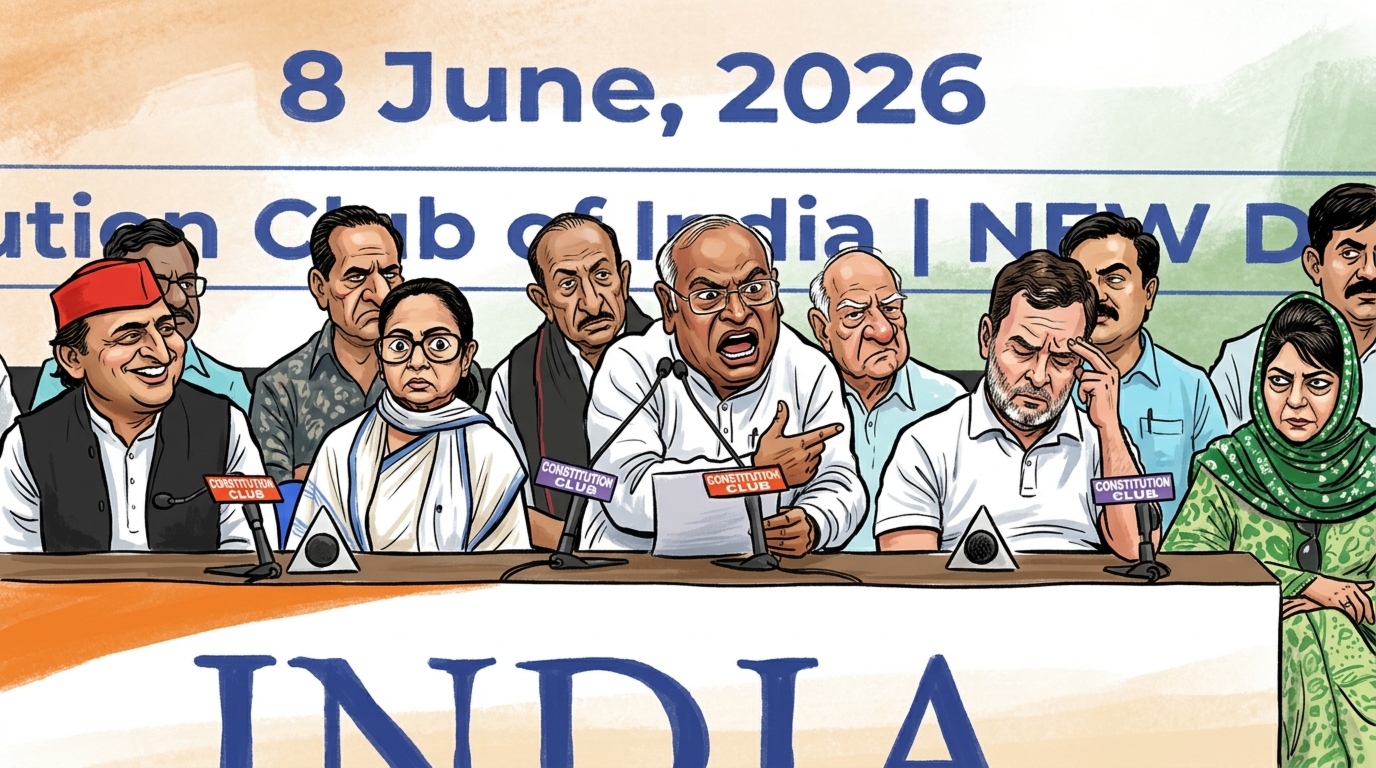
INDIA bloc joins CJP in attack on Education Minister
The opposition is linking exam chaos and the language row to argue the education minister has lost control of the ministry.
Overview
The education ministry has become a political pressure point for the , which is using the and controversies to argue that has lost credibility. What began as criticism of exam handling has widened into a broader attack on education policy, with the opposition portraying the as another sign of mismanagement while Pradhan insists the approach supports rather than .
Timeline
Follow-up letters and meetings planned
The bloc announces further coordination steps, including letters and additional meetings to sustain pressure on the government. Opposition leaders present the resignation demand as part of an ongoing campaign rather than a one-day protest. The issue remains active as a continuing opposition flashpoint.
Questions about this development
The bloc is preparing letters and more meetings to extend the campaign beyond a single protest. That suggests the resignation demand is being treated as an ongoing political effort, with repeated coordination used to sustain attention and momentum.
It shows the opposition wants to keep the issue active and visible rather than letting it become a one-day event. Continued meetings and correspondence are meant to preserve unity, sharpen the message, and force the government to keep responding.
More letters, meetings, and public statements are likely as the bloc tries to maintain pressure. The issue may continue as a recurring flashpoint if opposition leaders keep using it to coordinate broader attacks on the government.
Bloc ties education row to broader opposition agenda
Alongside the resignation demand, INDIA bloc leaders discuss other joint pressure points, including the and . The move shows the education controversy being folded into a wider opposition campaign against the government. This gives the Pradhan issue a larger strategic role inside bloc coordination.
Questions about this development
The bloc is turning the Pradhan issue into part of a wider pressure campaign so it can coordinate multiple grievances at once, rather than treating NEET and CBSE as a standalone fight. That makes the education row useful as a rallying point for joint opposition action.
Leaders are also discussing the SIR and vote-list issue, along with other shared concerns. By bundling these topics together, the bloc is trying to show a common opposition agenda and keep pressure on the government across more than one front.
It means the resignation demand is no longer only about exam controversies. Once the issue is folded into bloc-wide coordination, Pradhan becomes part of a broader political challenge to the government, which can keep the pressure alive even if the education dispute alone fades.
INDIA bloc coordinates on resignation demand
leaders meet and unanimously agree to seek Dharmendra Pradhan’s resignation. The bloc treats the education dispute as a coordinated opposition issue, not just a Congress complaint. The decision marks the point at which the criticism hardens into a formal joint demand.
Questions about this development
The criticism became a coordinated opposition demand for Dharmendra Pradhan’s resignation. That matters because it turns separate complaints into a joint political front, which usually carries more weight than party-by-party attacks.
It shows the bloc is treating the education controversy as a question of ministerial accountability, not just a policy disagreement. That raises the political stakes and suggests the opposition will keep the pressure on unless the government changes course.
Pradhan defends multilingualism policy
Dharmendra Pradhan rejects allegations of Hindi imposition and says the does not make Hindi compulsory. He presents the as a multilingualism measure rather than a push for any single language. That response becomes the government’s main defense against the opposition attack.
Questions about this development
He says the National Education Policy 2020 does not make Hindi compulsory and that the three-language approach is meant to support multilingualism. His defense is that the policy expands language learning rather than forcing one language on students.
It is trying to show that the policy is educational rather than ideological. By stressing that no single language is compulsory, the government is trying to blunt accusations that the ministry is pushing Hindi through school policy.
Opposition links language policy to exam failures
Congress and other voices connect the language row with the earlier NEET and CBSE controversies. They argue that the has mishandled both exams and policy design, turning the issue into a wider question of accountability. The criticism moves beyond education administration and into direct political pressure on the government.
Questions about this development
They are presenting both as evidence of the same pattern: poor handling of exams, weak policy design, and weak accountability. That lets them turn a curriculum dispute into a broader attack on the education ministry’s competence.
It widens the criticism from one policy controversy into a general claim that the ministry has mishandled multiple education issues at once. That makes the dispute politically harder to isolate and easier to use against the minister personally.
CBSE Class IX three-language rule triggers backlash
CBSE’s new for Class IX students, set to take effect from July 1, becomes a fresh flashpoint. Opposition parties say the rule adds an unnecessary burden on students and amounts to , especially in non-Hindi-speaking states. The policy dispute gives the opposition a new education-linked line of attack on the minister.
Questions about this development
Opposition parties say it adds another requirement for Class IX students without clear benefit and could be harder for non-Hindi-speaking states to implement. They are framing it as a language-policy decision with political overtones, not just a school curriculum change.
The dispute centers on whether the policy is seen as multilingual education or Hindi promotion. In states that already oppose language centralization, the rule gives opponents a fresh example to argue that the education ministry is favoring Hindi over regional languages.
Pradhan hits back at Rahul Gandhi
Dharmendra Pradhan rejects Congress attacks and says Rahul Gandhi is making baseless allegations without . He defends the government’s handling of , , and reform efforts. The exchange intensifies the political fight over NEET and CBSE.
Questions about this development
He rejected the allegations as baseless and said Rahul Gandhi was speaking without fact-checking. Pradhan also defended the government’s exam safeguards and digital evaluation reforms, trying to shift the argument from failure to ongoing correction.
He is trying to show that the ministry did not ignore exam security or assessment problems. By pointing to safeguards and reform efforts, he is arguing that the opposition is overstating the scale of the failures.
Rahul Gandhi demands Pradhan’s removal
Rahul Gandhi escalates the confrontation by directly calling for Dharmendra Pradhan to be . He argues that the minister has endangered students’ futures and says the government must answer for repeated exam failures. The becomes a recurring opposition line in the education row.
Questions about this development
It escalated the row from criticism into an explicit demand for political accountability. Once the opposition started calling for Pradhan to be sacked, the focus shifted to whether the government would accept blame for repeated exam failures.
It makes the dispute harder for the government to contain because it personalizes responsibility at the ministerial level. That keeps pressure on Pradhan whenever the opposition raises student grievances or exam irregularities.
CBSE evaluation row widens the education dispute
Congress leaders broaden their attack to include -related exam problems, including complaints about the and unfair results. Rahul Gandhi links the controversy with the and says Pradhan should have been removed earlier. The issue shifts from one exam scandal to a wider charge of ministerial failure.
Questions about this development
The criticism expanded from one exam leak to a broader claim that the education system was mismanaged. By linking CBSE marking complaints with the NEET controversy, Congress argued the problem was structural rather than isolated.
He used the CBSE complaints to argue that the ministry had failed across multiple exams, not just NEET. His point was that repeated problems showed a pattern of poor oversight, which is why he said Pradhan should have been removed earlier.
NEET paper leak sparks opposition attack
The paper leak controversy becomes a major political issue, with opposition leaders accusing the of failing students and mishandling . Rahul Gandhi demands accountability and says the education system has broken down for of candidates. The dispute turns Education Minister Dharmendra Pradhan into a central target for criticism.
Questions about this development
It became a wider attack on the government because opposition leaders framed the leak as proof that exam security had failed students. Rahul Gandhi said the system had broken down for lakhs of candidates, which turned the controversy into a question of ministerial accountability.
Dharmendra Pradhan became the central target because the opposition treated the leak as a failure of the education ministry, not just the testing agency. That shifted the dispute from an exam scandal to a direct challenge to his credibility.