
World
Europe's Early June Heatwave Kills Over 1,300
How is climate change making deadly heat domes 30 times more likely?
How is climate change making deadly heat domes 30 times more likely?
Europe is grappling with an unprecedented early-June heatwave driven by a persistent high-pressure that traps warm air and shatters temperature records across Spain, France, Germany, and Belgium. This lethal atmospheric event, intensified by , has pushed temperatures above 40°C, overwhelming healthcare systems and causing over 1,300 confirmed deaths, including vulnerable elderly populations and children. The crisis underscores the escalating stakes of climate-driven extreme weather, where rising temperatures not only trigger direct fatalities but also fuel indirect dangers like drowning, forest fires, and mass public health emergencies.
Italy's Health Ministry issued for more than 20 cities, including Rome, Milan, and Venice, as temperatures approached 40°C. The highest confirmed reading was 40.1°C in Bologna on June 29, with evident in Turin where repeated blackouts occurred due to .
Visual evidence confirmed that train tracks in Germany are melting due to extreme heat, illustrating the collapse of . Reports indicate only 20% of European homes have compared to 90% in the U.S., and older homes with are becoming 'furnaces' that trap heat, preventing recovery even at night.
WHO Director-General Tedros Adhanom Ghebreyesus confirmed over 1,300 across Europe since June 21 and warned that Europe is the fastest-warming continent, heating at twice the global average. He explicitly stated that the continent's infrastructure was not built to withstand such high temperatures, noting that 'once-in-a-generation' heatwaves are now occurring nearly annually.
The reported that more than 1,300 linked to high temperatures have been recorded across Europe since June 21, with France accounting for approximately 1,000 of these deaths. WHO Director-General Tedros Adhanom Ghebreyesus warned that Europe is the , heating at twice the global average, and that infrastructure was not built to withstand such extreme heat.
Barcelona has opened over 500 to help residents cope with extreme heat. Paris and Denmark have also launched welfare monitoring programs for elderly residents, while the called for legislation on maximum working temperatures for outdoor laborers.
Germany recorded its hottest day on record for the third consecutive day with 41.7°C in Coschen near the Polish border. Poland set a new national record of 40.5°C in Slubice, and the Czech Republic recorded 41.1°C in Doksany, the first time temperatures above 41°C were measured in the country's .
France's stated that 74 people have died from drowning since the beginning of the heatwave, with most deaths occurring in unsupervised bodies of water such as rivers, lakes, and ponds. This figure is significantly higher than the 55 drowning fatalities previously reported in the existing timeline.
Spain's reported at least 1,028 heat-related deaths during the recent heatwave, more than double the 407 deaths recorded in June 2025. Spain's national weather agency confirmed that the first six months of 2026 were the hottest ever recorded in the country, with June 2026 being the second-hottest June on record.
France's announced on June 27 that around 1,000 occurred between June 24 and June 27 due to the heatwave. 85% of victims were aged 65 and older, and deaths at home rose sharply by about 40% in the Paris region since June 24.
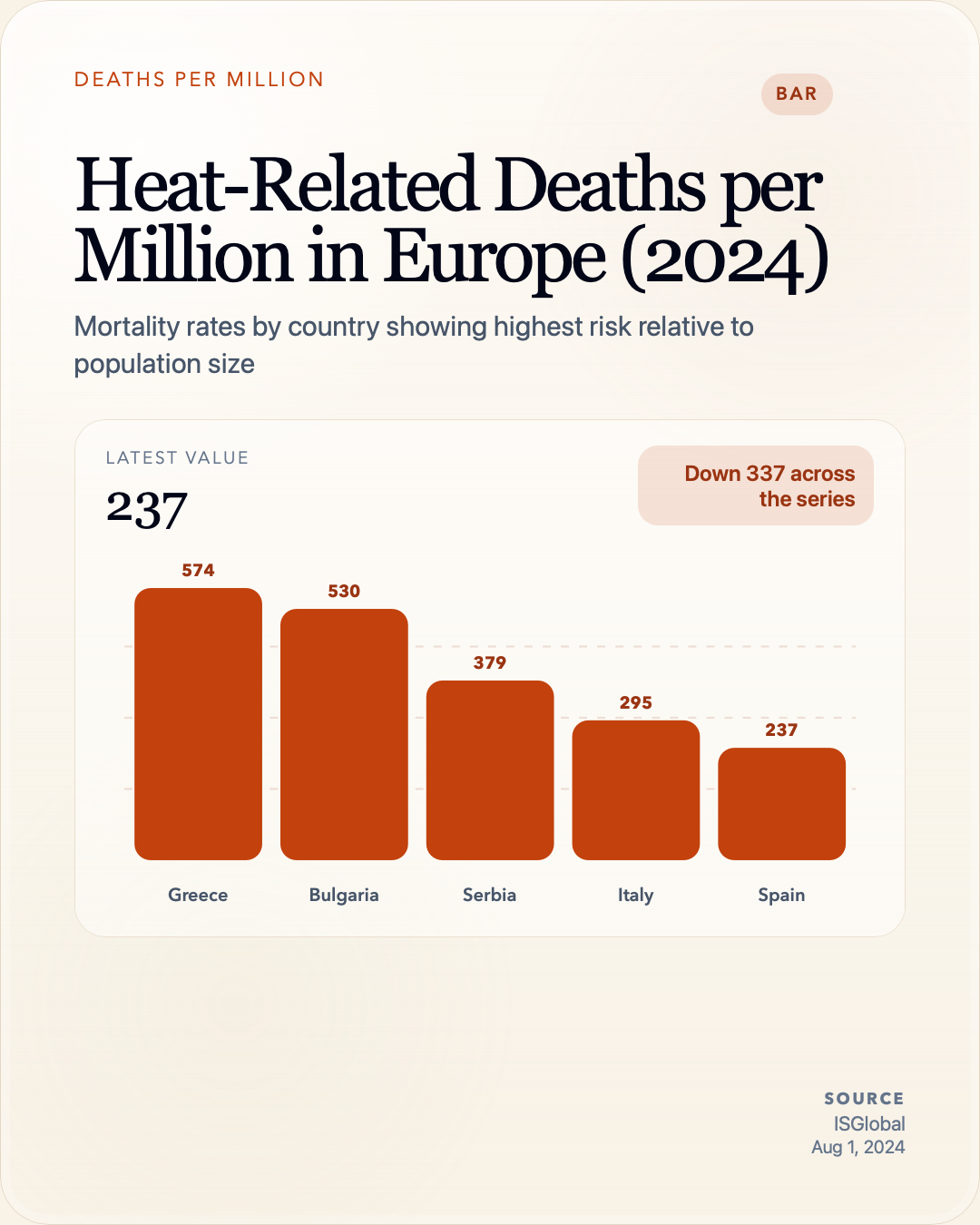
Scientists confirm the is exacerbated by human-driven climate change, noting that such events are now 30 times more likely than in the . The 62,000+ heat deaths in Europe during 2024 set a grim precedent for future escalation.
Authorities estimate over 1,300 excess deaths across Europe since June 21, with France reporting 1,000 alone. The heatwave's northward and eastward migration continues, with Greece facing wildfire risks and Eastern Europe issuing new .
As Spain's temperatures begin declining, a forest fire erupts northeast of Barcelona, forcing 16,000 residents indoors. An is arrested, linking the fire to the heatwave's dry, arid conditions and climate-driven wildfire risk.
An 18-month-old dies in Marseille after being left in a hot car, and a 3-year-old is found in Paris. Drowning fatalities in France rise to 55, with two-thirds in unsupervised swimming areas, highlighting the 's indirect lethal consequences.
French health authorities cancel two major concerts and public gatherings in Paris due to overwhelmed hospitals and resource strain. The French health minister warns of additional fatalities, triggering an for the Paris area.
The heat dome moves northward, with Germany recording 41.3°C in Arbr, its hottest ever, and Belgium hitting 40°C in Kleine Brogel. Over 150 million Europeans are exposed to temperatures above 35°C, and report being overwhelmed.
From Sunday to Thursday, Spain's records 327 temperature-related deaths, with the majority occurring in the last two days. This surge marks the first major mortality spike and confirms the heatwave's lethal impact on vulnerable populations.
By early June, southern Spain and parts of France reach 40°C, with seven confirmed deaths in Spain including a young child. The heatwave begins its west-to-east trajectory, overwhelming outdoor laborers and triggering initial across the region.
On Monday, the UK records its warmest May day at with 34.8°C, surpassing previous records. Temperatures rise to 35°C the next day, signaling the heat dome's initial reach and conditions 10–15°C above average across Western Europe.
A strong , known as a , begins forming over Western Europe, compressing air downward and trapping heat. This atmospheric lid prevents cloud formation and intensifies sunshine, setting the stage for unprecedented early-June temperatures across the continent.