
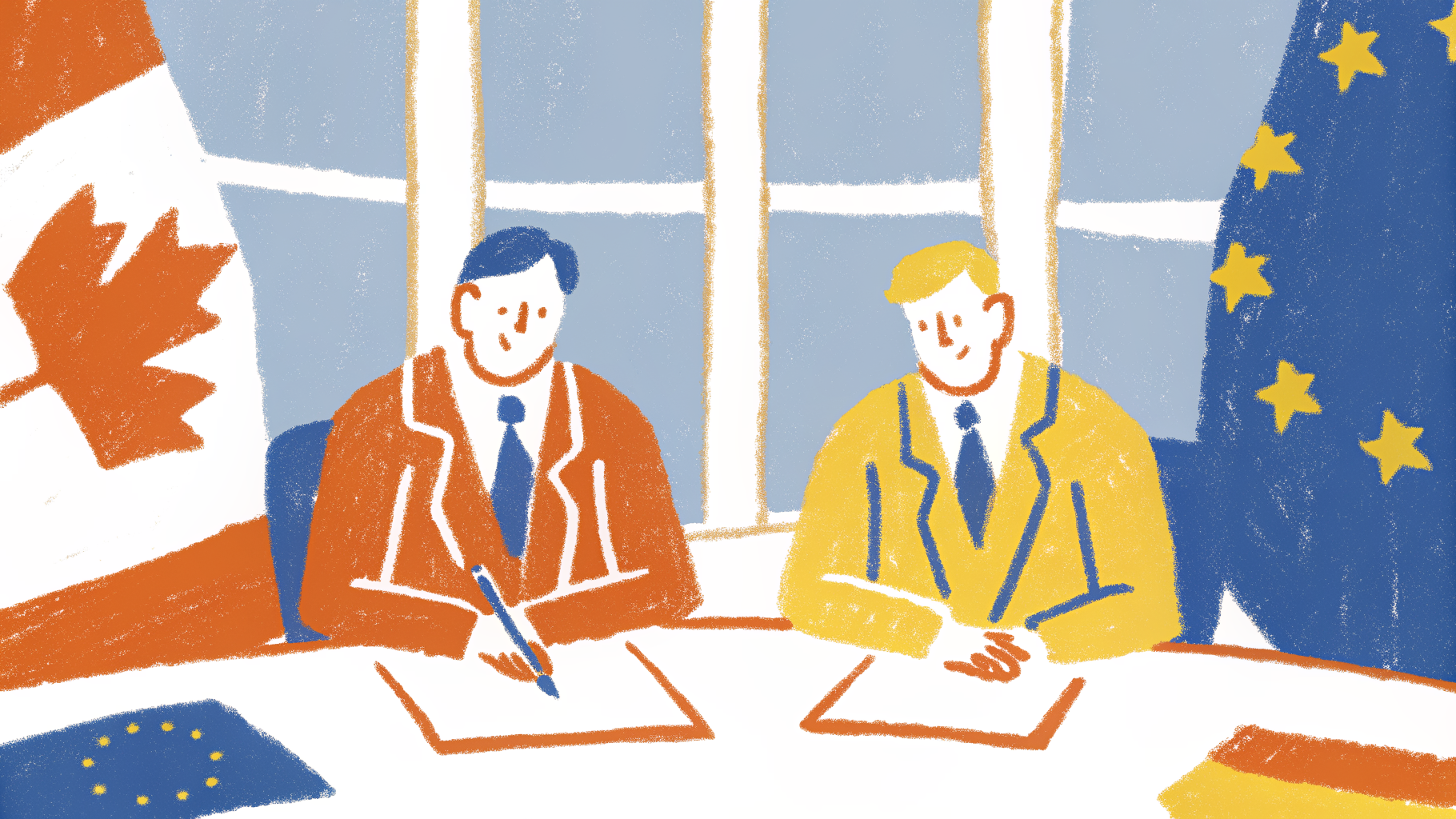
Canada and EU deepen defence ties with SAFE talks and mineral deals
Both sides seek more secure suppliers beyond uncertain U.S. policies
Overview
Canada and the European Union want to rely less on uncertain U.S. policies. They are linking defence, trade, minerals and advanced technology. Their ties rest on a , in force since 2017, and on . In June 2025, they added a . They also agreed to work toward Canada joining the EU’s . This could support shared weapons purchases and industry projects.
The plan also covers secure mineral supplies, investment, digital trade, , , online safety and shared rules. It could give both sides steadier suppliers and markets, while helping Canadian companies and attracting European investment. But the defence agreement is not a promise to defend each other. Its value will depend on funded projects, mineral processing, actual purchases and matching rules, not just protection from future U.S. policy changes.
Timeline
Canada and the European Union agreed terms allowing Canadian companies to participate in EU SAFE-supported defence procurement
The agreement lays down conditions for and Canadian-origin products to participate as in procurements supported by the EU’s instrument. This creates a direct link between the political defence partnership and EU financing. It could turn cooperation into industrial participation and joint procurement, subject to the instrument’s eligibility conditions.
Canada and the European Union moved from strategic declarations toward implementation through procurement, investment and digital negotiations
The partnership now has institutional foundations through the and , for raw materials and digital cooperation, and a defence framework linked to participation. The clearest test is whether these instruments produce funded projects, mineral investment, defence contracts, regulatory alignment and measurable supply-chain diversification. Current arrangements remain a set of partnerships rather than a legally binding Canada-EU strategic bloc.
Canada and the European Union chose a political partnership instead of a legally binding defence alliance
The Security and Defence Partnership reaffirms and groups existing activities under a common framework, but it does not create . Its value depends on follow-through through procurement, industrial cooperation, information exchange and operational coordination. This distinction limits the agreement’s immediate force while preserving flexibility for both sides.
Canada and the European Union expanded technology cooperation to artificial intelligence, quantum technology and cybersecurity
The 2025 strategic agenda treated advanced technologies as part of economic and national security. Cooperation covers artificial intelligence, cybersecurity and digital infrastructure, with the broader agenda also identifying , standards and technology-security concerns. The partners have not yet demonstrated a single integrated program matching the political scope of the agenda.
Canada and the European Union expanded critical-minerals cooperation toward investment and secure supply chains
The partners reaffirmed work to secure and diversify supplies of minerals and metals required for defence, clean energy and digital production. Their agenda includes trade and investment, processing capacity, research and innovation, and high environmental and social standards. The initiative is intended to make supply chains less exposed to geopolitical pressure.
Canada and the European Union agreed to pursue a Digital Trade Agreement alongside CETA
The planned agreement is intended to complement by addressing digital market access, data-related issues and regulatory friction. Leaders also committed to deepen work on artificial intelligence, cybersecurity, digital identity, and secure connectivity. Negotiations and implementation, rather than the announcement alone, will determine its practical effect.
Canada and the European Union signed a Security and Defence Partnership to consolidate cooperation under one political framework
The partnership brought together cooperation on , , maritime and space security, defence initiatives and information exchange. It also created opportunities for defence procurement and industrial cooperation. The agreement is non-legally binding, so it provides political direction rather than a mutual-defence guarantee.
Canada and the European Union launched a Digital Partnership in November 2023
The partnership created a framework for cooperation on artificial intelligence, , cybersecurity, digital infrastructure, online platforms and digital skills.
Canada and the European Union expanded cooperation on economic resilience and critical supply chains
Canada and the EU worked through CETA and related cooperation to strengthen energy security, critical-mineral supply chains and broader economic and technological resilience.
Russia’s invasion of Ukraine intensified Canada-EU cooperation on security, energy and critical minerals
After the , Canada and the EU worked more closely on support for Ukraine, , supply-chain resilience and critical-mineral cooperation.
Canada and the European Union launched a Strategic Partnership on Raw Materials to strengthen mineral supply chains
The partnership focused on needed for clean energy, digital industries and defence. It aimed to expand trade, investment, research and innovation while promoting environmental and social standards. The initiative addressed dependence on concentrated or politically vulnerable sources.
Canada and the European Union provisionally applied CETA to deepen their economic relationship
The reduced tariffs and expanded market access between Canada and the EU. CETA gave the political partnership a substantial commercial base and encouraged greater trade and investment. Its provisional application also created a platform for later economic-security cooperation.
Canada and the European Union provisionally brought their Strategic Partnership Agreement into force
Most of the agreement began operating provisionally after approval by the European Parliament. It created recurring channels for Canada-EU coordination while national ratification continued. Full entry into force still required ratification by EU member states because the agreement covers .
Canada and the European Union signed a Strategic Partnership Agreement to structure broader cooperation
The agreement created a framework for regular political dialogue and cooperation on international peace and security, trade, sustainable development, justice and freedom. It established the institutional foundation for a relationship extending beyond commerce. The agreement was signed alongside , linking political and economic ties.